

"Normal"
who holds the mirror?

I do this time and time again—viewing the world with some peculiar detachment. Looking over the towering buildings blocking my view of the sun, I only get a patch of sky between these glinted mirror boxes. I imagine the people inside these boxes, sitting in front of their company-issued computers like chess pieces on thirty-something floored chessboards. They talk, they stretch, they fill their tumblers with water from the dispenser, they poke a friend for a not-so-quick getaway and gossip in an empty lot down the block in a span of a stunted cigarette, they return with a cup of coffee in one hand and a wallet in the other, sometime in between perhaps taking a photo and perhaps posting about it; they make their patterned moves. They squint their eyes more exposed to the light flashing from their screens than from the sun I’ve been waiting for, and as if that’s not enough, they go home still with another screen to look at—smaller but far more entertaining. Only when as if awakened to consciousness they lift their heads—whether the mind is where the sight is, a different matter altogether. Here are the buildings, there are the mountains. Here is the pavement, there is the sea. This is civilization; water is commodified. People are strange, I think as I am momentarily blinded by the sun that finally showed itself in the small patch of sky like a gliding golf ball losing momentum. The phosphenes continue to paint my darkened vision and I stay still briefly content with my sun-kissed face my hands dared not cover. I return to myself.
A chess piece on a glinted chessboard, I am—in the corners of a room picking my nail folds, in front of a screen alternating too many tabs, in the middle of the street chasing kids, on the sidewalks of the city, in the car laughing or singing, in supermarkets pushing grocery carts and stopping by an aisle of necessities, in buses reading or privy to the cross spitfire dialogues of a young couple, on this marble bench sturdy on my back while my hand caresses the head of an orange stray cat—also making my patterned moves. But what dictates my inclinations?
In Sayaka Murata's satirical novella, Convenience Store Woman, she wrote,
“It is the start of another day, the time when the world wakes up and the cogs of society begin to move. I am one of those cogs, going round and round.”
I hear the long-repressed sigh of the soda can, and the bespectacled man sitting on another marble bench my shoes are pointing to—younged by the denim jumpsuit he’s wearing—hurriedly sips its burdens empty, salving his own. The sound and scene remind me of the book. My knees almost don’t feel pained from prolonged folding, and instead, I was the one standing behind the till, and without looking, I'd know from the distant bhub of a closed fridge someone had just chosen a drink or maybe left empty-handed. I remember Keiko, her particularity to the job, her devotion to it.
The story takes place in Japan, a country often regarded as a household of diligence and intense hustle culture. But Keiko is a 36-year-old woman who remains unmarried and has lived half her life working in a convenience store. It’s not a job, it’s a dead-end job—that’s the premise. What defines it as such is probably the salary grade and the lack of a ladder she’d anyway be unwilling to climb. Her friends and family find her strange for that and other reasons including her solitary lifestyle. They made her believe she needed to be cured. Of what?
Where do we draw the line between what is normal and what is not, and who creates the criteria? If Keiko is self-sufficient, uninterested in marriage, content with her so-called dead-end job, and maintains a reputable work ethic, does she still fall on the side of not normal for the conventional reasons of not hustling and marrying as normal people do?
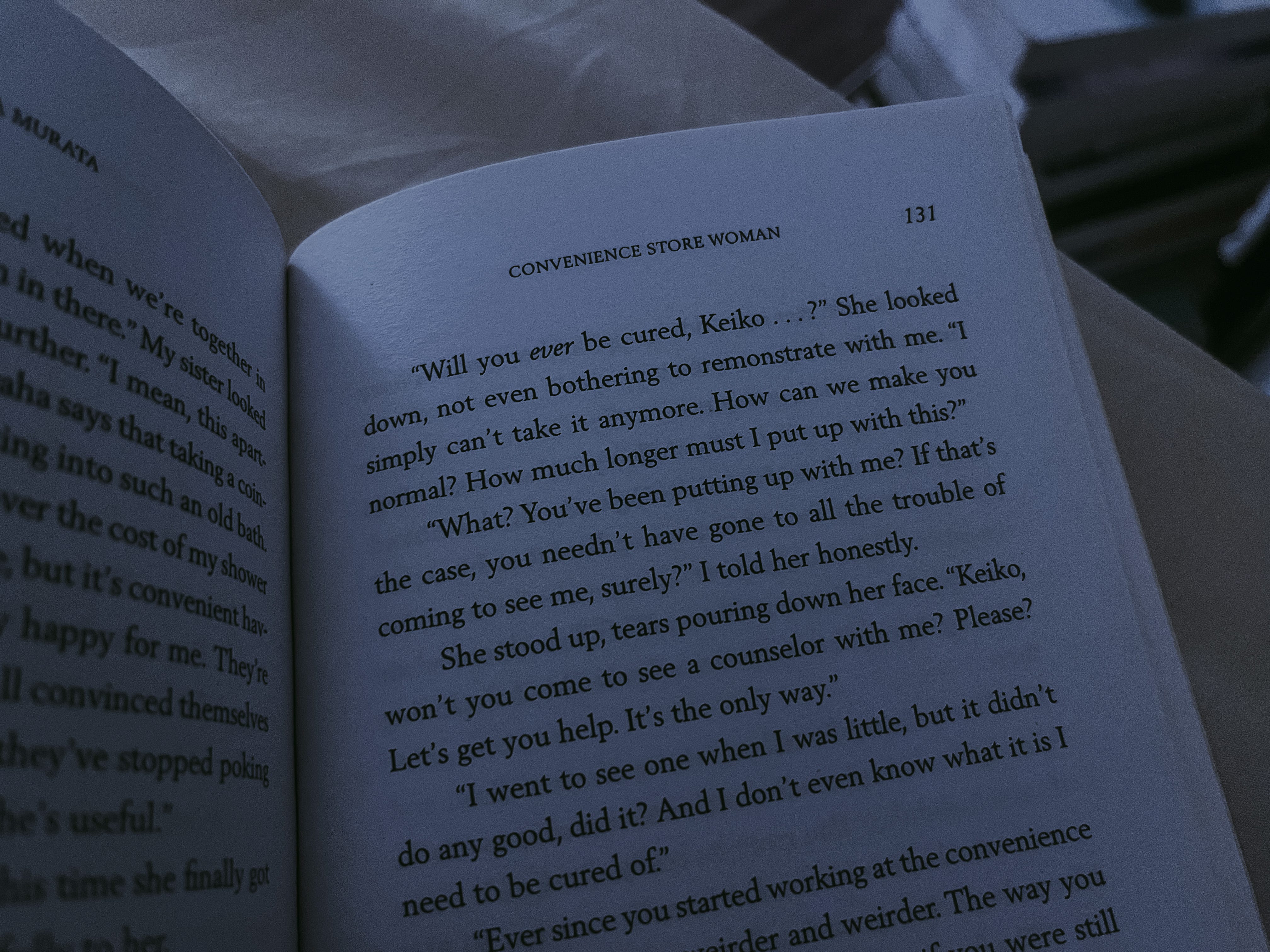
When she tries living with an intolerably lazy man she is incapable of loving and tells her sister about it, she muses, “She’s far happier thinking her sister is normal, even if she has a lot of problems, than she is having an abnormal sister for whom everything is fine.”
Her sentiment is like that of a carbonated drink washing my throat. It eases tension, but then it stings a bit. Perhaps most of us are susceptible to this—trying to see ourselves the way other people see us, and even the awareness of our uniqueness from each other is not enough to make our strangeness stop hurting.
“You eliminate the parts of your life that others find strange—maybe that’s what everyone means when they say they want to ‘cure’ me,” Keiko says. While she is more curious than miserable, it does affect her; otherwise, she wouldn’t constantly try to change herself as she sees fit for others. Like her, who made quietness a solution for people’s disapproval of her unusual frankness whenever she speaks and realized later on those people still find her quietude eccentric, I have also tried fitting into the normal patterns of the world, convinced there is something inherently wrong with me when my normalcy do not align with what the world seems to say how I should be. I have second-guessed myself, fidgeted at the edge of my seat, doubted my ways of being and most valued predilections, and corrected what people think weird. Sometimes it’s their euphemistic comments, often it’s their eyes—some perceived error in my behavior, a disgusting strangeness committed by my hands.
One time while I was eating outside with my family, I took a photo of a Texas combo appetizer made of potato skins and cheesy jalapeño bites. Then my head summoned stories on Instagram like quickly flipped pages of a notebook. It’s another of the strange patterns we do, I thought. I didn’t post it. But in the times that I do, what was my purpose behind it? I tried convincing myself that it was some sort of talisman for the good times, as if in not doing so I’d fail to keep a memory, but I was content at the moment, so much so that I trusted my forgetful mind to remember. I tried thinking of it then as an expression of gratitude, but I was well aware of the gratefulness residing within that the appetizing photo failed to communicate. To me, it was just that: a photo. It didn’t mean anything and I couldn’t keep convincing myself otherwise.
But this is also the normal life on the screen even if sometimes I find it strange.
Is the intention to display or to express? Rarely do I have qualms about sharing something outside of myself like a world wonder or a work of art made by others, but when it comes to the more personal events this is the question I argue with most. Whether this is normal or not, I don’t know. But I get curious about my motives. What lies in my subconscious, what pushes and pulls. Could it be what Emily Dickinson felt—the imbalance of the interior and exterior outmatching each other—having to keep most of her writings to herself? Was her reclusion the most natural to her, the most authentic and rewarding, or was it the culmination of outward disappointments, estrangements, hurts, fears? What did she think of putting herself out into her little world? Did she see the importance or the pointlessness in it? This brings to mind a quote from Virginia Woolf, “But then one would have to decide what is style and what is meaning.” If the intention is not solely for meaning, what am I inadvertently expressing in the things I display?
There was a time when I didn’t have to ask. When my outward concerns were more about the conveyance of wonder, creating and sharing, and less about proofs of life. I’ve always wanted to only do things with meaningful intentions. But I am a faulty human being; I don’t always, then I’d feel the weight of my impulses—so trivial, so pointless, so devoid of meaning. There used to be no need for self-celebration to prove I was living. There was no need to prove I was living at all. Or if there was, it took less weight, less headspace. Less pressure and more being.
Now it’s like I’m living in the age of the self. Everywhere I look is a mirror within a mirror within a mirror. The oversaturation of it is tiring. Or maybe I’m just tired of myself, of letting their eyes hurt and acting upon it, of knowing despite this that I still take part in it. I still yield to this human need of showing up and turning myself into the cogs of a normal society whenever I see my faults, my inevitabilities, and my unusualities pointed out to me like a distorted mirror warping all my hideous idiosyncrasies. I’d turn on the faucet and wipe it with my wet hands in a futile attempt to make them go away but they never do. All it does is more blurring, more warping.
Perhaps it could be rooted in something that remains unresolved in me, as if part of my existence is a problem; it could be that there is indeed something that needs to be cured, as if part of myself is a disease of some sort. It could be that I’m falling into a binary way of thinking and getting caught up once again to the noise of the world when after all, everything is nuanced and seems to be a shot at nothing.
Who holds the mirror? It takes so little to convince.
It’s afternoon. The way the buildings glitter is a beauty to behold. Sitting up, the needles prickle my feet from curling on this marble bench half the length and width of a single bed. My pinky fingers are numb and my knees feel arthritic while stretching. I realize it’s whenever I force myself to fit in that I struggle most to belong to myself.
The wind whistles Mary Oliver’s voice, bringing an unusual coolness in the skyrocketing summer heat. “One day,” she says, slowly letting the distorted mirror dry,
“One day you finally knew
what you had to do, and began,
though the voices around you
kept shouting
their bad advice—”
Spring arrived earlier than expected, which is strange, which is scary, but perhaps our collective actions make it the most normal thing to be happening. We’re careless and it’s inevitable. What do I expect? Strange is normal too. People are strange, so I am, so we all are. Even to the point of destruction. There’s too little in what we see and so much in what we don’t, and we try to make up for it while the world spins like a dog chasing its own tail.
Meanwhile, my faults are still faults. My inevitabilities will continue cascading like water landing on the surface of steel before it reaches the sink. It all goes down the sink, doesn’t it? My unusualities will make up most of my tendencies and I will continue making my patterned moves. There’s no way to checkmate society, but an impasse could be reached—the one inevitable move of being my own cog. I can learn from Keiko, what she does in the end. A shattering of the distorted mirror I forced to see myself in.
“But little by little,
as you left their voices behind,
the stars began to burn
through the sheets of clouds,”1
Perhaps, after all, this is what Sayaka Murata’s trying to say.
“Go ahead. Do what’s normal for you. Anyway. Be your own kind of strange.”
“She’s far happier thinking her sister is normal, even if she has a lot of problems, than she is having an abnormal sister for whom everything is fine.”
how telling this statement is, it makes you wonder if people’s discomfort with those who don’t conform to the norm says more about them and their inability to face anything that may unsettle the conventions they’ve subscribed to. they may then have to question many of the choices they’ve made, “strange” parts of themselves they’ve sacrificed - i think it takes a lot more courage to be authentic and “abnormal” ;)